Bernarda Alba—Poncia
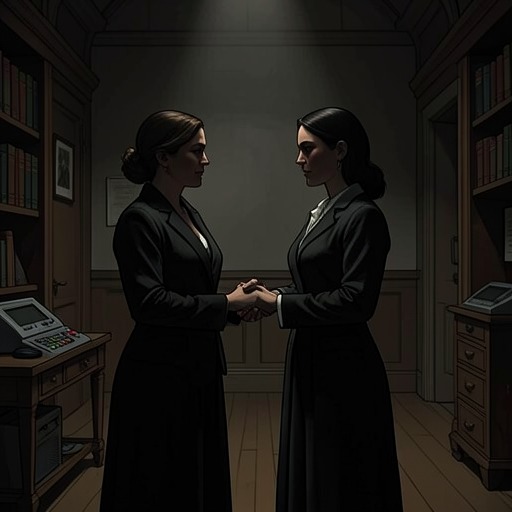
The House of Bernarda AlbaBernarda Alba and Poncia’s relationship is shaped by thirty years of service, close knowledge, and an unyielding divide in status. Poncia has helped maintain Bernarda’s household and has watched over its private affairs, but Bernarda continues to treat her as a subordinate rather than an equal. Poncia’s practical insight repeatedly brings her close to the truth about the household’s conflicts; Bernarda’s pride and insistence on authority turn that insight into a warning she refuses to heed.
A Long Service Under Unequal Terms
Poncia has worked in Bernarda Alba’s house for thirty years. She recalls washing Bernarda’s sheets, eating her leftovers, staying awake when Bernarda coughs, and watching the neighbours through cracks so she can bring Bernarda news. Her account describes more than domestic labour: Bernarda has relied on Poncia as an intimate observer of the household and village, and Poncia has consequently acquired extensive knowledge of the people around her. Yet the familiarity does not erase the hierarchy. When Poncia speaks as though the two women’s long history might make them old friends, Bernarda rejects the suggestion: Poncia serves her and is paid, she says, and nothing more.
That dismissal is especially sharp because their relationship is not merely formal. Poncia knows Bernarda’s habits and vulnerabilities, while Bernarda has depended on her labour and information for decades. Poncia’s complaint that there are no secrets between them sits beside her anger at being kept in a subordinate position. Their closeness therefore has two edges: it gives Poncia the knowledge to challenge Bernarda, but it also makes her service and exclusion more painfully apparent.
Practical Knowledge and Mutual Hostility
Poncia’s common sense comes from experience, and she uses it both to advise the daughters about men and marriage and to interpret the tensions around them. She knows Bernarda’s strengths and weaknesses well enough to provoke her with pointed observations, and she sometimes turns the household’s inequalities to her own advantage, including by taking food. Her conduct is neither simple loyalty nor open independence: it is a resourceful response to a relationship in which Bernarda has the greater power and Poncia has accumulated knowledge.
The conflict becomes explicit when Bernarda accuses Poncia of speaking with a poisonous tongue. Poncia appeals to their long acquaintance, but Bernarda answers by reducing their bond to wages and service. The exchange makes the limits of their intimacy plain. Poncia can speak candidly, and she can unsettle Bernarda, but she cannot make Bernarda acknowledge her as a social equal. Bernarda’s authority is economic as well as personal, and her language restores that hierarchy whenever Poncia presses against it.
Warnings Bernarda Refuses
Poncia’s strongest interventions arise when she recognizes that serious trouble is developing among the daughters. After Bernarda has dismissed the household’s quarrels, Poncia tells her that something grave is happening that she does not understand. Bernarda responds not by investigating the warning but by invoking Poncia’s disreputable origins and servant status. The rebuke turns a potentially useful disclosure into another contest over rank.
Poncia nevertheless supplies a concrete piece of information: Pepe el Romano has been seen speaking with Angustias at half-past four in the morning. The report brings the concealed tensions around Angustias’s engagement and her sisters’ feelings into the open, though Angustias denies it and Bernarda again asserts her authority. Poncia’s warning is thus accurate in its larger implication that the household’s private arrangements are unstable, but Bernarda’s response is to defend control rather than examine what the evidence means.
The Household Crisis and Its Larger Meaning
The women’s unequal relationship belongs to a wider social order in which Bernarda’s wealth gives her power over both her employees and her daughters. Poncia shares many of Bernarda’s traditional assumptions about gender and reputation, and she too fears disgrace. Yet her position as a servant gives her a different vantage point: she sees the household’s workings from inside while remaining excluded from the authority Bernarda claims. Their conflict shows that knowledge and power do not coincide. Poncia can perceive danger without being able to compel Bernarda to act.
That gap acquires its sharpest meaning when Bernarda’s concern for family reputation overrides attention to the crisis around her. In the closing events, she insists that Adela died a virgin and orders the household to maintain silence. Her response confirms the priority she has given throughout the play to authority and public appearance. Against this, Poncia’s repeated warnings stand as an account of what Bernarda’s command cannot control: the hidden conflicts are real, and refusing to hear about them does not prevent their consequences. The relationship is therefore both a portrait of a long, unequal domestic bond and a mechanism through which the play reveals the limits of Bernarda’s rule.